Beyond Bitcoin: Understanding the Difference Between Blockchain and Crypto


Introduction

When people hear the word blockchain, the first thing that often comes to mind is Bitcoin or cryptocurrency. While it’s true that blockchain technology powers cryptocurrencies, the two terms are not interchangeable. In fact, the widespread association of blockchain with crypto has caused significant confusion and even skepticism in the general public.

This blog post aims to clear up that confusion. We’ll explain the fundamental difference between blockchain and cryptocurrency, and explore the wide array of real-world applications of blockchain technology — far beyond digital currencies.


What Is Blockchain?

At its core, blockchain is a type of distributed ledger technology (DLT). Think of it as a secure, digital record-keeping system that is shared across a network of computers. Each record (or “block”) is linked to the previous one, forming a “chain” that is immutable — meaning it cannot be altered once added.

The key features of blockchain include:

  • Transparency: Everyone in the network can view the same data.
  • Security: Data is encrypted and validated through consensus mechanisms.
  • Decentralization: No single authority controls the network.
  • Immutability: Records are permanent and tamper-proof.

What Is Cryptocurrency?

Cryptocurrency is a digital or virtual currency that uses cryptography for security. Cryptocurrencies like Bitcoin, Ethereum, and many others use blockchain to record transactions securely and transparently.

In simple terms:

Cryptocurrency is just one application of blockchain technology — not the technology itself.


Why the Confusion?

The confusion arises because Bitcoin was the first popular application of blockchain technology. For many people, their first and only exposure to blockchain has been through crypto trading, investing, or news coverage related to scams, price swings, or regulatory crackdowns.

This limited exposure creates the false impression that blockchain equals cryptocurrency, which is far from the truth.


Blockchain Applications Beyond Cryptocurrency

Here are several industries where blockchain is being used today — without involving cryptocurrencies:


1. Supply Chain Management

Blockchain allows companies to track goods from their origin to the end consumer. This improves transparency, prevents fraud, and ensures ethical sourcing (e.g., tracing whether diamonds or cocoa are conflict-free).

Example: IBM’s Food Trust platform helps companies trace the journey of food items, improving safety and reducing waste.


2. Healthcare

Blockchain can be used to secure patient records, ensuring that data is accessible only to authorized parties and protected from tampering or hacking.

Example: MedicalChain and other projects use blockchain to allow patients to control access to their own health data.


3. Voting Systems

Blockchain can power secure, transparent, and tamper-proof digital voting, potentially solving problems of election fraud and increasing voter trust.

Example: Estonia and some U.S. states have piloted blockchain voting systems.


4. Digital Identity

Blockchain can be used to create self-sovereign digital identities that are secure and verifiable — reducing identity theft and simplifying access to services.

Example: Projects like ID2020 and Sovrin aim to provide blockchain-based digital identity systems for refugees and underserved populations.


5. Finance and Banking (Beyond Crypto)

Banks are using blockchain for cross-border payments, smart contracts, and real-time settlement — increasing speed, reducing fees, and improving security.

Example: JP Morgan’s Onyx platform and RippleNet use blockchain for fast, international transactions without relying on cryptocurrencies directly.


6. Real Estate and Land Registry

Blockchain can simplify the process of buying and selling property by recording ownership, preventing fraud, and reducing paperwork.

Example: Countries like Sweden and Georgia have adopted blockchain to record land titles.


7. Education and Credentials

Universities and institutions are issuing tamper-proof academic certificates on the blockchain that are instantly verifiable by employers.

Example: MIT issues blockchain-based diplomas that graduates can share with employers or institutions globally.


Final Thoughts

It’s time to separate the technology (blockchain) from just one of its use cases (cryptocurrency). While cryptocurrencies have their place, the potential of blockchain stretches far beyond digital coins.

From revolutionizing healthcare and education to transforming government and finance, blockchain is poised to be one of the most impactful technologies of our time.

Understanding this distinction helps us better embrace innovation — and move past the hype or fear often associated with crypto headlines.


Call to Action
If you’ve only associated blockchain with Bitcoin, now is the time to dig deeper. Explore how this powerful technology can transform industries and improve trust, transparency, and efficiency in everyday life.

Stay informed. Stay curious. The future is blockchained — with or without the coins.

Stablecoins: The New Front in U.S.–China Financial Power Rivalry


Introduction

Stablecoins—digital tokens pegged to fiat currencies or other assets—have evolved far beyond crypto curiosities. Today they represent a critical battlefield in the U.S.–China competition for influence over global monetary systems.


1. What Are Stablecoins?

A stablecoin is a cryptocurrency designed to maintain stable value by being backed 1:1 with assets like U.S. dollars, gold, or government bonds (Atlantic Council).
Market capitalization reached roughly $240–260 billion in 2025, dominated (83%) by U.S.-based issuers such as USDT and USDC (BeInCrypto).


2. U.S. Strategy: Regulatory Clarity and Dollar Dominance

In March–July 2025, the U.S. advanced and enacted the GENIUS Act, establishing a comprehensive federal stablecoin framework: full asset backing, audits, consumer protections, and issuance controls (Wikipedia).
Proponents argue this strengthens the U.S. dollar’s position and draws institutional participation, while critics warn of risks like tax evasion, pseudo-anonymity, and fragile liquidity (washingtonpost.com).


3. China’s Response: Digital Yuan and Regulatory Counters

China regards U.S. dollar-backed stablecoins as a strategic threat. Former central bank officials warn they may deepen dollarization, undermining China’s monetary sovereignty (scmp.com).
As a response, China is pushing faster development of its digital yuan (e‑CNY) and exploring offshore yuan stablecoins—especially in Hong Kong as a regulatory sandbox (cryptonews.com).


4. Hong Kong’s Role: A Testing Ground

Hong Kong passed its Stablecoin Ordinance in May 2025, effective August, marking the city as a gateway for yuan-based stablecoins under strict reserve and licensing rules (Forbes, techinasia.com, Coinlive, Cointelegraph).
Fintech firms raised over $1.5 billion recently to build stablecoin infrastructure, while equities tied to Hong Kong issuance saw a market correction viewed by experts as healthy rebalancing (Reuters).


5. Strategic Stakes: Beyond Payment Rails

While some see stablecoins primarily as crypto tools, their broader implications include:

  • Increasing demand for U.S. Treasurys, potentially lowering borrowing costs; issuers such as Tether already hold billions in U.S. government debt, influencing yields (arxiv.org).
  • Competition between Project Agorá (Western‑led digital payments infrastructure) and mBridge (Asia‑led via central banks) illustrates the infrastructure divide (ft.com).
  • China’s push for yuan-based systems is part of its broader ambition to shift global finance from the dollar zone (thediplomat.com, ccn.com).

6. Key Tensions & Perspectives

IssueU.S. PerspectiveChinese / Hong Kong Perspective
Currency InfluenceReinforce dollar‑based global financeCounterbalance via yuan‑pegged systems
Regulatory ApproachGENIUS Act: streamlined licensing & auditsHong Kong pilot regime; tight compliance
Sovereignty & ControlEncourages market competitionPrioritizes state control over value flow
Financial StabilityConcern over liquidity stress & bank runsRisk of USD stablecoin dominance in Asia

7. What’s Next?

  • U.S.: Implementation of GENIUS enforcement, audit regimes, and integration with Wall Street players like Meta, Visa, Bank of America (BeInCrypto, Business Insider).
  • China/Hong Kong: Launch of yuan‑pegged stablecoins via state‑backed firms like Ant Group, North King, and testing via Hong Kong compliance regime (Cointelegraph, cryptonews.com, Cointelegraph, Reuters).
  • Global Competition: EU and UK exploring euro‑based alternatives under MiCA and FCA frameworks, pushing for multipolar stablecoin networks (axios.com, onchainstandard.com).

Conclusion

Stablecoins now stand at the crossroads of global finance and geopolitics. The U.S. seeks to institutionalize dollar-backed tokens under a regulated framework, while China accelerates its national digital currency ambitions through yuan alternatives. Whether stablecoins emerge primarily as financial tools or geopolitical instruments depends on how these systems evolve—and which financial blocs gain the trust of global markets.


RWA代币化:将现实世界资产引入Web3的创新路径


近年来,RWA代币化在Web3领域成为热门话题,但实际应用案例并不多。然而,随着加密货币逐渐被主流机构视为一种新的投资资产类别,RWA代币化作为一种创新工具正在崛起,可将非流动性资产转化为更具流动性和包容性的数字资产。

值得一提的是,比特币ETF(BTC ETF)和以太坊ETF(ETH ETF)并不属于RWA代币化。比特币ETF仅持有比特币这一资产本身,并未通过区块链上的代币形式代表所有权。而RWA代币化是指将现实世界中的资产(如房地产、股票或债券)在区块链上进行数字化表示。


比特币ETF与RWA代币化的比较

比特币ETF:

  • 关注点:让投资者获得比特币价格的敞口。
  • 运作机制:投资公司购入并持有比特币,投资者则购买ETF份额,这些份额代表一部分比特币持仓。
  • 非代币化:ETF并不等同于区块链上的代币,不存在通过区块链转移所有权。
  • 本质:ETF是股票市场的产品。

RWA代币化:

  • 关注点:将实体资产(房地产、股票、债券等)以代币形式在区块链上代表其所有权。
  • 运作机制:资产被转化为数字代币,实现可分割所有权、便捷交易及其它区块链优势。
  • 区别于比特币ETF:RWA代币化不用于直接投资比特币,而是用于代币化其它现实资产。

核心区别:

比特币ETF持有的是加密资产本身,而RWA代币化则是将其它现实资产数字化并上链。


RWA代币化的实际案例

1. 房地产代币化

房地产被视为相对安全的投资方式,但门槛高、流动性差。尽管房地产是全球最大的资产类别(总价值达228万亿美元),但散户投资者常因高额起投金额、流动性低、管理成本高等原因而被排除在外。

近几十年来,房地产证券化(如REITs、房地产基金、房地产ETF和众筹)一定程度上降低了散户参与的门槛,但仍存在限制,例如高起投额及无法直接投资于单个项目。

如今,一种新型证券化形式——房地产代币化(即RWA代币化)正在兴起。通过将房地产拆分为数字代币,资产所有者可更高效融资,投资者则可获得前所未有的透明度和流动性。

实际案例:法国巴黎 AnnA Villa

这座价值650万欧元的别墅成为法国首个通过区块链交易完成销售的房产。过程如下:

  1. 产权转让至“SAPEB AnnA”公司;
  2. 公司所有权被分割为10个以太坊代币;
  3. 每个代币进一步拆分为100,000份,即每份仅需€6.50即可投资。

2. 债券与股票代币化

债券代币化

每个代币代表对债券的利息及本金的索取权。相关条款通过智能合约编写。

优点:

  • 结算更快
  • 减少中介
  • 全球可访问
  • 流动性更高

案例:

  1. 欧洲投资银行(EIB) – 2021年发行1亿欧元数字债券(以太坊网络)
  2. 汇丰银行+新加坡政府 – 2023年在Orion平台上代币化新加坡政府债券,实现原子结算

股票代币化

代币与真实股票挂钩(1:1托管或模拟合约)。代表股票的权益,可全天候交易。

优点:

  • 24/7全球交易
  • 支持碎片化持有
  • 开放全球投资者参与

案例:

  1. FTX交易所(已倒闭) – 提供特斯拉、苹果等股票代币,1代币 = 1股票,由德国CM-Equity托管
  2. Swarm Markets(欧盟合规) – 提供苹果、特斯拉及美债代币,允许加密投资者合规投资传统资产

3. 艺术品与文物代币化

将艺术品、历史文物等现实资产的所有权或经济权利转为区块链上的数字代币,支持全权所有、共享所有权、或利润分配权。

案例:

  1. Masterworks.io
    • 拆分高价值艺术品(如Banksy、Warhol)
    • 获SEC批准,可在二级市场交易
  2. Particle Collection
    • 代币化Banksy的《Love Is in the Air》
    • 拆分为10,000个NFT,每个代表“粒子”,并记录在链上
  3. Artex 平台
    • 目标:将博物馆、画廊收藏的画作代币化
    • 支持代币交易、质押和投资
  4. RARE Network
    • 结合NFT和现实认证机制
    • 提供真品鉴定、储存验证

技术流程:

  • 评估与托管:资产经鉴定并储存在安全场所
  • 法律结构:资产由LLC等实体持有,代币代表股权
  • 发行代币:基于Ethereum、Avalanche或Polygon等平台
  • 智能合约:控制所有权转移、分红、转售等
  • 二级市场交易:可在OpenSea或专属平台买卖

挑战:

问题说明
法律问题如何确保代币持有者的合法权益
估值难度艺术价格波动大
托管风险必须安全保存实物
法规不确定某些国家将其视为证券
流动性问题艺术市场本身交易频率低

应用场景

  • 散户拥有高价值艺术品的部分所有权
  • 博物馆通过代币筹集资金
  • 艺术家控制作品转售及获取版税
  • 文博机构通过代币化吸引公众参与文化遗产保护

总结

RWA代币化通过将现实资产数字化,为传统资产注入流动性、可分割性和透明度,架起传统金融与区块链之间的桥梁。

尽管仍面临法规、技术和市场等挑战,但这一领域正快速发展,有望在不久的将来迎来广泛应用。


Real Estate Tokenization

Real estate has always been considered a safe investment compared to the stock market. However, it is also more expensive and illiquid. Though real estate is the largest asset class with a global value of $228 trillion, many retail investors are precluded from investing in this asset class, particularly commercial real estate. Barriers to entry include large upfront investment, very low short-term liquidity, management costs, among others. Therefore, how to make investing in real estate more affordable and accessible to retail investors has become an urgent matter.

In recent decades, a process known as securitization of real assets has reduced the frictions and costs associated with accessing real estate exposure for such retail investors. Among financial instruments that provide indirect investment via securitization of real assets, the most common are public and private real estate investment trust (REIT), real estate investment fund, Real Estate Exchange Traded Funds (ETFs), and real estate crowdfunding. Though investors can already buy and sell real estate investment trusts (REIT), but these often have high minimum investments and represent a large portfolio of companies rather than a single property or new development.

To work around the issues, a new form of securitization known as tokenization of real estate has emerged and is gaining popularity. Tokenization helps asset or fund owners raise capital more efficiently, and gives investors unprecedented access to private real estate investments, transparency, and liquidity.

Tokenization is a way to securitize real assets by dividing them into shares that can be sold to investors. It involves representing ownership of an interest in real estate with virtual tokens that exist on a blockchain which is known as security tokens. These tokens are created using blockchain technology, and once created can be traded on digital exchanges or Alternative Trading Systems (ATS).

An actual tokenization use case happened in Paris recently. The property is known as AnnA Villa, which is valued at € 6.5 million. The Villa became the first-ever property in France that was sold via a blockchain transaction. The transaction took place in three steps. First, the ownership of the building was transferred to a joint-stock company called “SAPEB AnnA.” Next, the ownership of the company was divided into 10 Ethereum-powered tokens which were distributed among the new owners. In the final step, each of these tokens was then further broken down into 100,000 units, meaning each token has a face value of € 6.50. Therefore, you can invest as little € 6.50 in the villa.

Another good use case is Fracproperty in Australia. They have obtained Australian financial services  licence(ASFL) to implement real estate fractionalization. Now at STO stage and currently airdropping their tokens. The tokens will allow you to enjoy fractional rental income and capital gain. You can sign up with this invitation link below to receive 10 FRAC token via the airdrop.

Sign Up to Receive Free FRAC token

Advantages of Tokenization

The main advantage of real estate tokenization is improved liquidity. Liquidity means the ease with which an asset can be bought or sold as the cost of entry will be reduced. Tokenization allows a real asset to be subdivided into smaller units and sold as security tokens to potential investors. For example, a 5000 sqft property that costs $1,000,000 can be divided into 100,000 tokens, and each token sold at $10, a price much more affordable to retail investors.

In addition, tokenization will widen the market reach by creating a global investment pool that can extend the real estate market to buyers and sellers from around the globe. Anyone with sufficient capital and an internet connection can easily participate in buying and selling real estate located anywhere in the world.

Other advantages include the following:

  • Transparency: Blockchain is a public distributed ledger so every transaction of the security tokens can be tracked and accessible to anyone.
  • Security: Blockchain is a distributed ledger that is encrypted using advanced cryptography. Every transaction is encrypted into a hash which is not hackable.
  • Immutable: Once a transaction has been submitted to the blockchain and subsequently confirmed, the data cannot be altered. This means no one can falsify the transactions and hence frauds can be prevented.
  • Improved Operational Efficiency: Smart contracts can automate processes such as compliance checks, investor whitelisting, and post-issuance matters including dividend distribution, thereby reducing cost and settlement time.

Implementation

Implementation of a real estate tokenization project involves the following matters that must be dealt with:

  • White Paper-we need to prepare a whitepaper to describe the tokenonomics, the business model, the technological requirements, legal compliance, and more.
  • Type of Tokenization- We need to decide what interest to tokenize, the real asset itself, the equity of a real estate, a mortgage of the property, or others.
  • Asset Information-Type of asset, whether residential or commercial, the property owner, location of the property, etc.
  • Tokenization Ratio-Whether to tokenize part or entire property
  • Smart Contract-The smart contract must address the questions like the total supply of tokens, the amount of tokens to be distributed to holders, do the holders receive dividends, and so forth. Besides that, you must decide the token standard, usually, we adopt ERC20. In addition, the smart contract must be audited by a certified auditing firm.
  • Securities Regulation-Real estate tokens are securities therefore must be registered with regulatory bodies like SEC.
  • Tax-The earnings from the tokens may be subjected to taxes such as property gain tax etc, must engage tax experts to work out the tax structure and strategy.
  • KYC/AML– Real estate token issuers must comply with AML and KYC laws and regulations. 

Tokenization Process

Basically, real estate tokenization involves the following steps:

  1. Asset Identification—identification of the real estate asset, whether it is commercial or residential, and its location. Besides that, it may involve the acquisition, financing, and appraisal of its value.
  2. Smart Contract Generation—Taking compliance with securities laws into consideration in the creation of the smart contract;
  3. Token Creation—determination of the total supply and type of tokens.
  4. Marketing and Distribution—advertising of the offering, confirmation of investor accreditation and listing of tokens on the exchange through a security token offering (STO); and
  5. Post-Listing Support—ongoing support for investors and distributing dividends or other rights to payment.

Example Real Estate Tokenization: Aspen Coin


A good example of a real estate tokenization project is Aspen Coin. A real estate asset management and advisory firm by the name of Elevated Returns LLC issued a token that represents ownership of Aspen Digital Inc, a Maryland corporation formed with the sole purpose of owning the St. Regis Aspen Resort. Tokenization was handled by the token issuer platform known as Securitize (digital security issuance platform). In addition, Templum, a registered broker-dealer and alternative trading system managed the primary distribution, and Computershare (shareholder services) provided custodianship. Marketing was also supported by Indiegogo, a crowdfunding platform. The project successfully raised $18 million.

The tokenized securities were exempt from registration via Regulation D, and therefore were offered and sold only to accredited investors by means of a private placement memorandum. The minimum investment was set at $10,000. Besides that, dividends are to be distributed on-chain to the token holder wallet using Ether. Secondary trading
is provided by Templum to whitelisted investors, and whitelisting is also provided by Templum.

References

Tokenization Explained

What is Tokenization?

Tokenization has become a buzzword today due to its adoption in the payment industry and blockchain. However, Its usage is not limited to the aforementioned industries. It can be applied to many other industries such as healthcare, stock trading, gaming and more.

The primary purpose of tokenization is to ensure data security. It is used for handling sensitive data such as payment, medical record, personal ID and more.

According to Wikipedia,

“Tokenization, when applied to data security, is the process of substituting a sensitive data element with a non-sensitive equivalent, referred to as a token, that has no extrinsic or exploitable meaning or value. The token is a reference (i.e. identifier) that maps back to the sensitive data through a tokenization system. The mapping from original data to a token uses methods which render tokens infeasible to reverse in the absence of the tokenization system, for example using tokens created from random numbers.

The tokenization system must be secured and validated using security best practices applicable to sensitive data protection, secure storage, audit, authentication and authorization. The tokenization system provides data processing applications with the authority and interfaces to request tokens, or detokenize back to sensitive data.”

In short, Tokenization is the process of substituting sensitive data with non-sensitive identification symbols known as tokens. Tokenization retains all the essential information of the data without compromising its security.

A Short History

According to Wikipedia, the concept of tokenization has existed since the invention of the currency system centuries ago. It was adopted as a means to reduce risk in handling financial instruments by replacing them with surrogate equivalents.

In addition, coin tokens have a long history of use replacing the financial instrument of minted coins and banknotes. In more recent history, tokens are used in mass rapid transit payment, casino chips and more.  The adoption of the above systems is to replace physical currency and cash for reducing risks such as theft.

In the digital world, tokenization techniques have been used since the 1970s. They were meant to isolate real data elements from exposure to other data systems(Wikipedia, 2018). In databases, surrogate key values have been used since 1976 to isolate data associated with the internal mechanisms of databases and their external equivalents for a variety of uses in data processing.

More recently, these concepts have been extended to consider this isolation tactic to provide a security mechanism for the purposes of data protection. For example, in the payment card industry, tokenization is one means of protecting sensitive cardholder data in order to comply with industry standards and government regulations.

Definition in Blockchain

In blockchain, tokenization is a method that converts rights to an asset into a digital token. Thus, we can take an asset, tokenize it and create its digital representation that lives on Blockchain. Blockchain guarantees that the ownership information is immutable.  The tokens created in this way is also known as crypto tokens.

For example, you can tokenize an asset such as a book that you authored. The book is kept somewhere while the book token is uploaded to the blockchain network. The book crypto token is a representation of the book ownership. You can specify how many tokens need to be transferred to your crypto wallet before you can transfer the book ownership to a buyer by means of a smart contract.

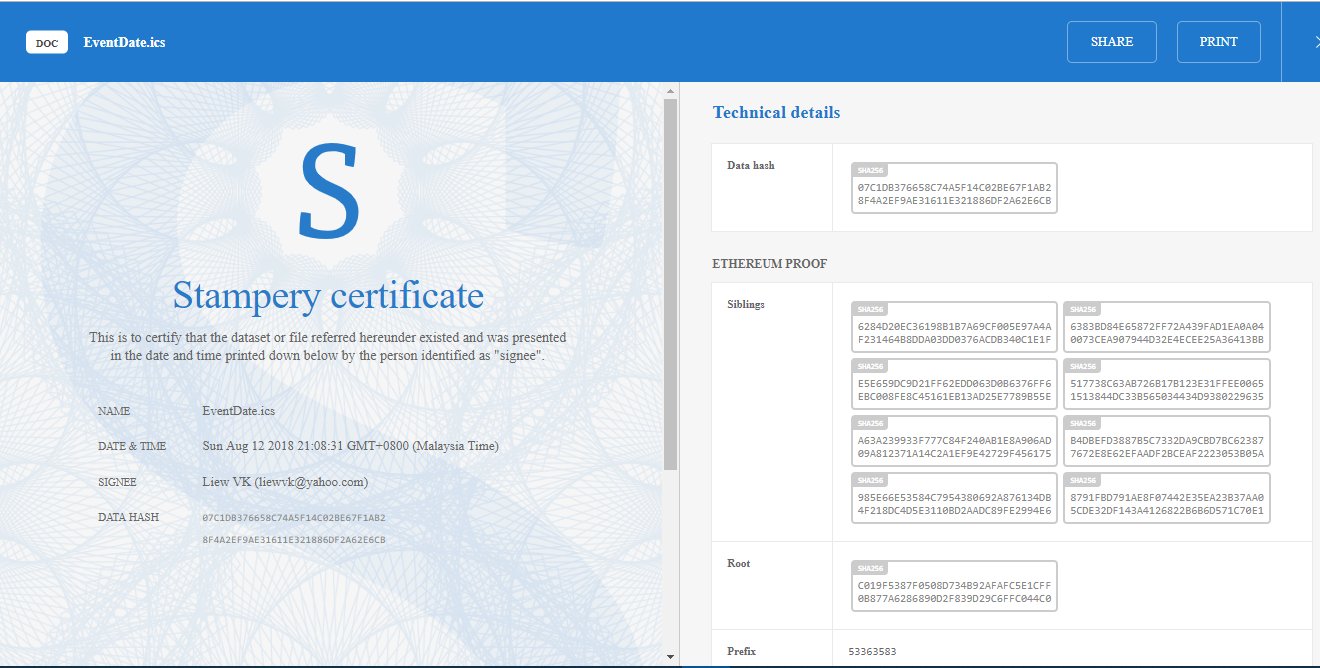
One of the actual use cases is https://stamp.io , a platform where you can store your tokenized documents on the block and certify it, as shown in the following figure:

Cryptokitties is a brilliant example of the crypto token that allows users to acquire an adorable collectible by transferring some cryptocurrencies to the owner. The owner will then transfer the digital collectible to the buyer. The transaction occurs automatically via the smart contract.

Another use case is we can create a crypto token that represents some customer loyalty points on a blockchain. This type of token is also known as utility token. It can be used to manage customers’ reward schemes for the retail chains. Other examples include the crypto token that gives entitlement to the token holder to view certain hours of video streaming on a video-sharing blockchain. A house owner can sell his house by transferring the tokenized house deed to the buyer. Last but not least, a crypto token may even represent another cryptocurrency.