What is DeFi?

DeFi stands for decentralized finance, which means operating financial applications on a decentralized platform such as blockchain. It is the new financial architecture that leverages decentralized networks and decentralized technologies such as smart contracts to transform old financial products into trustless and transparent protocols that run without intermediaries.

In contrast, centralized finance means a single organization such as a bank controls and manages the funds of the clients. This kind of centralized control has many weaknesses, including the abuse of funds and manipulation of personal data, frauds, single point of failure due to hacking, and more. 

Decentralized finance has many advantages as it’s aligned with the characteristics that blockchain technology possesses.

The Advantages of DeFi

Maintain Full Control of your own digital Assets

The digital assets that you own on a DeFi platform solely belong to you alone and you have the freedom to use it in whatever ways you like, without the interference of an intermediary. There is no centralized authority, such as a bank, with the ability to freeze your account, seize your assets, or block your transactions.

Increased Accessibility

According to the World Bank, globally there are still approximately 1.7 billion unbanked adults. These people are at a disadvantage when it comes to pursuing many financial opportunities that could improve their socioeconomic status and lift them out of poverty.

Unfortunately, centralized financial institutions don’t have an incentive to target this population. The revenue they would receive from providing services to the currently unbanked simply doesn’t justify the costs of reaching them. In contrast, DeFi providers operate without expensive intermediaries hence they are more willing to serve the underprivileged people. Furthermore, DeFi is borderless and ‘permissionless’ hence everyone on earth particularly the unbanked population can access this form of affordable financial services. Therefore, DeFi has the potential to reduce the world’s poverty.

Opportunity to own a portion of an expensive asset

Another DeFi application is tokenized assets. Tokenizing assets is creating digital tokens to represent the ownership of real assets that can be traded like securities such as shares. By creating tokenized assets that represent, say, a portion of a real estate investment, you open up the investment for people who previously couldn’t afford it, to having access from anywhere in the world.  Almost anyone can trade tokenized assets as he or she is not required to commit to an entire high-value investment at once. Instead, he or she has the option to buy or sell just a portion of the asset.

Transparency

 DeFi data is publicly available, enabling you to keep service providers honest. For instance, you can easily check the reserves of a DeFi bank, shop around for accurate loan rates, or even track the transactions of public figures.

Let’s examine a well known use case of DeFi, the Maker DAO

Maker DAO

MakerDAO is an open-source project on the Ethereum blockchain and a Decentralized Autonomous Organization created in 2014. The project is managed by people around the world who hold its governance token, MKR.

MakerDAO is a decentralized credit platform on Ethereum that supports Dai, a decentralized, unbiased, collateral backed stablecoin whose value is pegged to USD. The Maker Protocol which is known as Multi collateral Dai (MSD) allows users to mint Dai by leveraging collateral assets approved by the Maker Governance. Maker Governance is a community organized and operated process of managing various digital assets of the Maker Protocol.

The Maker Protocol is one of the largest dApps on the Ethereum blockchain. It was the first DeFi application to gain significant adoption among the crypto communities. Since the release of Single Collateral Dai in 2017, user adoption of this stablecoin has increased dramatically. Indeed, It has become a driving force in the DeFi movement. The Maker Protocol is designed by a diverse group of individuals that include developers, external partners, other persons, and entities. It is managed and governed by people who hold the governance token MKR through a system of scientific governance involving executing voting and governance polling.

Anyone can use the Maker Protocol to open a Collateralized Debt Position (CDP), lock ETH as collateral, and generate Dai as a debt against that collateral. Dai debt incurs a stability fee (i.e., continuously accruing interest), which is paid (in MKR) upon repayment of borrowed Dai.

The MKR is burned, along with the repaid Dai. Users can borrow Dai up to 66% of their collateral value (150% collateralization ratio). CDPs that fall below that rate are subject to a 13% penalty and liquidation (by anyone) to bring the CDP out of default. Liquidated collateral is sold on an open market at a 3% discount.

Holders of Maker’s other token (MKR) govern the system by voting on, e.g., risk parameters such as the stability fee level. MKR holders also act as the last line of defense in case of a black swan event. If the systemwide collateral value falls too low too fast, MKR is minted and sold on the open market to raise more collateral, diluting MKR holders.

I shall discuss more DeFi use cases in coming articles.

References

Crypto Fund Management: Latest Trends, Regulations, and Institutional Insights


The cryptocurrency fund management industry is rapidly evolving, driven by new regulations, strong market performances, and a surge in institutional adoption.

Whether you are a crypto hedge fund manager, institutional investor, or retail participant exploring digital asset funds, understanding these changes is essential for making informed investment decisions.


1. Regulatory Updates Shaping Crypto Fund Management

The global regulatory landscape for digital asset funds is becoming more defined, with the U.S. leading the way.

GENIUS Act Signed

The GENIUS Act (Guaranteeing End-to-End Integrity for the US Stablecoin System) is the first U.S. federal framework for stablecoins, requiring:

  • 1:1 asset backing with U.S. dollars or low-risk assets.
  • Dual federal and state oversight.
  • Enhanced audit and compliance obligations.

CLARITY Act Introduced

The Digital Asset Market Clarity Act provides:

  • A clear distinction between digital commodities and securities.
  • Defined regulatory roles for SEC and CFTC.
  • New licensing requirements for crypto exchanges and DeFi platforms.

Joint Risk-Management Guidance

U.S. financial regulators jointly issued new guidelines for banks offering crypto custody services, focusing on:

  • Risk assessments for operational security.
  • Custody asset segregation.
  • Incident reporting protocols.

2. Institutional and Market Developments

Record-Breaking Performance

Crypto hedge funds are outperforming traditional funds:

  • Fasanara Digital: +7% gains.
  • Edge Capital: +8.3% year-to-date.
  • Bitcoin reached a new all-time high of around $123,000.
  • Ether surged over 50%, boosting the total crypto market cap by hundreds of billions.

New Institutional Products

  • Solv Protocol launched BTC+, a yield-generating vault for idle institutional Bitcoin holdings, targeting the $1T+ institutional BTC market.

Rising Institutional Allocation

  • Reports show 47% of traditional hedge funds now have digital asset exposure, up from 29% just a few years ago.

3. Compliance and Operational Considerations

Crypto-Asset Reporting Framework (CARF)

  • OECD’s CARF will require all Crypto-Asset Service Providers to report customer transactions and tax details, starting with EU member states.

Tokenization on the Rise

  • Real estate, private equity, and even Islamic finance assets are being tokenized.
  • Platforms like J.P. Morgan’s Kinexys are leading large-scale adoption of tokenized investment products.

Summary Table — Crypto Fund Management Landscape

CategoryKey Highlights
RegulationGENIUS Act, CLARITY Act, U.S. custody risk-management guidance
Market TrendsHedge fund outperformance, BTC+ yield vault, Bitcoin ATH
ComplianceCARF rollout, rapid tokenization adoption

Key Takeaways

  • The regulatory framework for crypto funds is stronger than ever, reducing uncertainty for institutional investors.
  • Institutional adoption is accelerating, with hedge funds and banks creating structured products for Bitcoin and Ethereum.
  • Compliance requirements are expanding globally, especially with the introduction of CARF.
  • Tokenization will likely be one of the biggest disruptors in asset management over the next few years.

💡 Pro Tip: Fund managers should prepare now by integrating robust compliance systems, exploring yield-enhancing products, and diversifying exposure across tokenized and traditional digital assets.


References

Blockchain-based Event Management and Ticketing Platform

The event management and ticketing industry is a huge market, particularly the event management software market. Markets Insider reported that the Event Management Software Market is projected to grow from USD 5.7 billion in 2019 to USD 11.4 billion by 2024, at a CAGR of 15% from 2019 to 2024.

However, despite the great potential of the event and ticketing industry, there are numerous problems and issues plaguing the current centralized event ticketing industry. The main issues include ticket counterfeiting, ticket scalpers, instant sell-outs and overpriced resale tickets on secondary markets (EventChain, 2017).

The good news is that the blockchain could fix the aforementioned issues.  A blockchain is a distributed digital ledger that can be used to record transactions and other data across a decentralized peer-to-peer network made up of a cluster of computing devices.

Using blockchain technology, every ticket sales can be publicly verified, and thus the authenticity of the ticket can be guaranteed. It is also able to prevent fraudulent sales and counterfeiting. It sets rules (using smart contracts) preventing secondary ticket websites from hoarding tickets and charging inflated prices for premium events. If the rules are broken, the fraudulent accounts are frozen and the tickets are made invalid.

In a nutshell, a blockchain-based event and ticketing system has the following benefits:

  • Elimination of ticket duplication and counterfeit tickets
  • Elimination of scalpers
  • Elimination of ticket touts and purchasing bots
  • Fully transparent ticketing aftermarket
  • Automatic refund at the time of cancelation

Use Cases

BitTicket

The Edinburgh-based Citizen Ticket is an event ticketing platform backed by blockchain technology that uses the cryptocurrency Ethereum Classic. In May 2017, they deployed the blockchain-based ticketing system BitTicket and delivered the first live event using blockchain technology.

BitTicket is a ticket delivery service that event organisers, venues, and artists can use to secure their tickets with blockchain technology. BitTicket provides users with one wallet QR code that holds all their BitTickets securely, no matter which ticketing provider they bought them from. They simply present it along with proof of ID to gain entry. Due to the security of BitTicket identity, ticket transfer to friends and family can be done easily and with assurance. BitTickets are immutable, transferable, and verifiable.

BitTicket guarantees the following:

  • Your purchased ticket is genuine
  • Inherent protection against industrial-scale ticket touts and ticket purchasing bots
  • Transfer your tickets securely and with ease between friends & family
  • Provides one wallet for all your tickets – no more individual tickets

GUTS

GUTS uses blockchain technology to create a transparent ticketing ecosystem where inflated secondary market prices and ticket fraud are eliminated. Their motto is simple, transparent and secure.

GUTS brings numerous benefits for different stakeholders:

  • Artist and Managers
    • A fair chance for all the fans to attend the show
    • Expand the fan base with exact data
    • Direct communication with your fans. Send them a message right before the show starts.
  • The Venue, Festival and Theatre Operators
    • No ticket fraud: fewer complaints and a stronger image
    • You know exactly who is present at any time (and who isn’t)
    • Automatic refund procedure at the time of cancelation or resale
    • Identification via mobile phones means shorter queues
  • Ticket Providers
    • Complete control of the tickets in both the primary and secondary market
    • Easy to integrate with existing ticketing solutions

LAVA

LAVA is a blockchain-based ticketing system that guarantees fair and secure smart tickets for music lovers. The system prevents ticket touting and fraud ruining festivals for music lovers.

The LAVA ecosystem has the following features:

  • 100% Safe
    • Using latest blockchain technology to eliminate ticket fraud
  • Smart Tickets
    • Smart tickets to stop the exploitation of festival tickets using a unique digital footprint
  • Lava Wallet – Eliminate printing completely by generating the ticket digitally and sending the digital ticket to the Lava wallet directly
  • No booking fee

PouchNATION

PouchNATION is an event management software system that uses the blockchain technology to good effect. PouchNATION is the first platform to implement blockchain and new digital currency across all verticals in event management. Its components comprise guest registration, cashless payment, access control, activity tracking, social engagement and detailed analytics reporting.

This innovative platform could overcome issues that the ticket industry is currently facing with managing events, attendance tracking apps, eliminating duplicate tickets, and validating registration at the door.

They have executed over 100 events including cashless events in Indonesia, Philippines, Vietnam, Malaysia, Thailand, and Myanmar.

EventChain

EventChain is a global Smart Ticketing blockchain project that will allow events worldwide to sell SmartTickets through a peer-to-peer network, solving the issues of the centralized event ticketing industry.

It implements the EventChain token network for event management to ensure faster transactions, indisputable ticket vouchers, transparency from event hosts and fully flexible and programmable SmartTickets. With the use of the EVC token, smart contract code, and the Ethereum blockchain, EventChain’s transaction network brings increased accountability, transparency, and security to event ticketing.

To fix the excessive ticket fees, EventChain is distributing EVC tokens, a digital ERC20 token created for buying, selling, and programming SmartTickets on the Ethereum distributed network. EventChain claims that their transaction fees are much lower and the transaction confirmation speed is near seconds.

Event Management and Ticketing Platform-A Conceptual Model

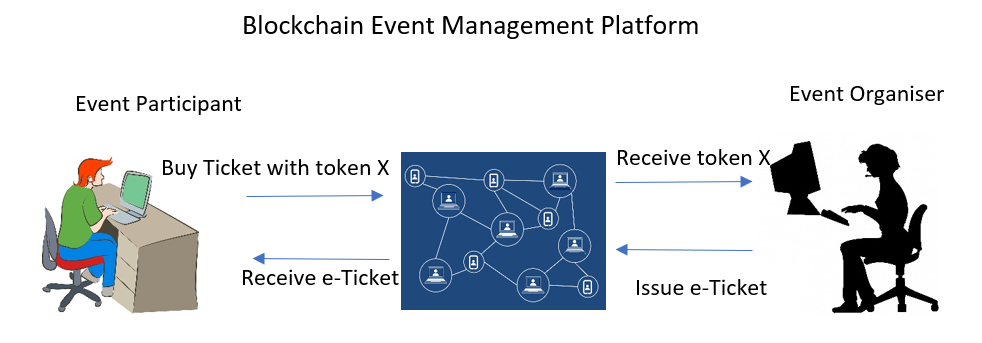
After examining the above use cases, I propose a conceptual model that utilises a similar concept to develop a blockchain-based event management and ticketing platform. Below is a simple conceptual model of the Event Management and Ticketing Platform:

The platform allows an event organizer to create an event and broadcast it to the website as well as a mobile wallet. The event should comprise details such as event title, date, time, venue, and a ticketing ordering button. The participant can then order tickets by paying  Token X. Once the organizer receives Token X, the e-ticket shall be automatically delivered to the participant’s mobile wallet. To enter the event venue, the organizer just needs to scan the e-ticket of the participant.

To build the platform, we need to build a smart contract layer on top of blockchain network to automate the buying and selling of event tickets. We shall use Solidity to write the contracts. There shall be at least three smart contracts -the ERC20 token contract(to generate Token X),  the event contract, and the ERC721 ticket contract. The event contract will need to link to the ticket contract as it needs to use the data in the ticket contract. The keyword to access the data in another contract is import. For example, we can create an event contract event.sol that imports the ticket contract ticket.sol, using the syntax as follows:

Pragma Solidity ^0.5.0
import "./ticket.sol"; 

The event.sol file shall create an event contract that specifies event details such as total tickets, collected funds, start time, etc. The code could be as follows:

Contract Event { 
 struct EventDetails {  
 uint256 ticketAmount; 
 uint256 SoldticketAmount; 
 uint256 CollectedFunds; 
 uint256 StartTime; 
  } 

The event contract shall also include a create event function, as follows:

function CreateEvent{
 uint256 _ticketAmount; 
 uint256 _Startime 
}

There are many more functions to be included in the smart contracts but I will not dwell further as this is not a technical paper.

References


Event Management and Ticketing Platform

The event management and ticketing industry is a huge market, particularly the event management software market. Markets Insider reported that the Event Management Software Market is projected to grow from USD 5.7 billion in 2019 to USD 11.4 billion by 2024, at a CAGR of 15% from 2019 to 2024.

However, despite the great potential of the event and ticketing industry, there are numerous problems and issues plaguing the current centralized event ticketing industry. The main issues include ticket counterfeiting, ticket scalpers, instant sell-outs and overpriced resale tickets on secondary markets (EventChain, 2017).

The good news is that the blockchain could fix the aforementioned issues.  A blockchain is a distributed digital ledger that can be used to record transactions and other data across a decentralized peer-to-peer network made up of a cluster of computing devices.

Using blockchain technology, every ticket sales can be publicly verified, and thus the authenticity of the ticket can be guaranteed. It is also able to prevent fraudulent sales and counterfeiting. It sets rules (using smart contracts) preventing secondary ticket websites from hoarding tickets and charging inflated prices for premium events. If the rules are broken, the fraudulent accounts are frozen and the tickets are made invalid.

In a nutshell, blockchain-based event and ticketing system has the following benefits:

  • Elimination of ticket duplication and counterfeit tickets
  • Elimination of scalpers
  • Elimination of ticket touts and purchasing bots
  • Fully transparent ticketing aftermarket
  • Automatic refund at the time of cancelation

Use Cases

BitTicket

The Edinburgh-based Citizen Ticket is an event ticketing platform backed by blockchain technology that uses the cryptocurrency Ethereum Classic. In May 2017, they deployed the blockchain-based ticketing system BitTicket and delivered the first live event using blockchain technology.

BitTicket is a ticket delivery service that event organisers, venues, and artists can use to secure their tickets with blockchain technology. BitTicket provides users with one wallet QR code that holds all their BitTickets securely, no matter which ticketing provider they bought them from. They simply present it along with proof of ID to gain entry. Due to the security of BitTicket identity, ticket transfer to friends and family can be done easily and with assurance. BitTickets are immutable, transferable, and verifiable.

BitTicket guarantees the following:

  • Your purchased ticket is genuine
  • Inherent protection against industrial-scale ticket touts and ticket purchasing bots
  • Transfer your tickets securely and with ease between friends & family
  • Provides one wallet for all your tickets – no more individual tickets

GUTS

GUTS uses blockchain technology to create a transparent ticketing ecosystem where inflated secondary market prices and ticket fraud are eliminated. Their motto is simple, transparent and secure.

GUTS brings numerous benefits for different stakeholders:

  • Artist and Managers
    • A fair chance for all the fans to attend the show
    • Expand the fan base with exact data
    • Direct communication with your fans. Send them a message right before the show starts.
  • The venue, Festival and Theatre Operators
    • No ticket fraud: fewer complaints and a stronger image
    • You know exactly who is present, anytime (and who isn’t)
    • Automatic refund procedure at the time of cancelation or resale
    • Identification via mobile phones means a shorter queue
  • Ticket Providers
    • Complete control on the tickets at both the primary and secondary market
    • Easy to integrate with existing ticketing solutions

LAVA

LAVA is a blockchain-based ticketing system that guarantees fair and secure smart tickets for music lovers. The system could prevent ticket touting and fraud ruining festivals for music lovers.

The LAVA ecosystem has the following features:

  • 100% Safe
    • Using latest blockchain technology to eliminate ticket fraud
  • Smart Tickets
    • Smart tickets to stop the exploitation of festival tickets using a unique digital footprint
  • Lava Wallet-Eliminate printing completely by generating the ticket digitally and sending the digital ticket to the Lava wallet directly.
  • No booking fee

PouchNATION

PouchNATION is an event management software system that uses the blockchain technology to good effect. PouchNATION is the first platform to implement blockchain and new digital currency across all verticals in event management. Its components comprise guest registration, cashless payment, access control, activity tracking, social engagement and detailed analytics reporting.

This innovative platform could overcome issues that the ticket industry is currently facing with managing events, attendance tracking apps, eliminating duplicate tickets, and validating registration at the door.

They have executed over 100 events including cashless events in Indonesia events in Indonesia, Philippines, Vietnam, Malaysia, Thailand, and Myanmar.

EventChain

EventChain is a global Smart Ticketing blockchain project that will allow events worldwide to sell SmartTickets through a peer-to-peer network, solving the issues of the centralized event ticketing industry.

It implements the EventChain token network for event management presents to ensure faster transactions, indisputable ticket vouchers, transparency from event hosts and fully flexible and programmable SmartTickets. With the use of the EVC token, smart contract code, and the Ethereum blockchain, EventChain’s transaction network brings increased accountability, transparency, and security to event ticketing.

To fix the excessive ticket fees, EventChain is distributing EVC tokens, a digital ERC20 token created for buying, selling, and programming SmartTickets on the Ethereum distributed network. EventChain claims that their transaction fees are much lower and the transaction confirmation speed is near seconds.

A Conceptualised Event Management and Ticketing Platform

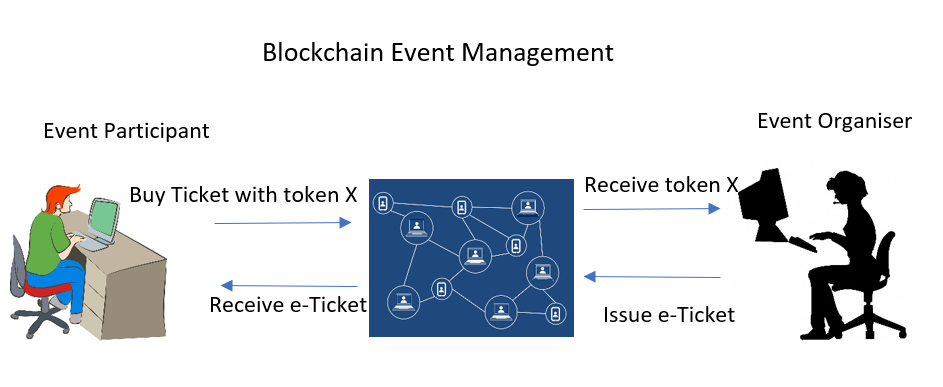
After examining the above use cases, I propose that we can use a similar concept to develop blockchain-based event management and ticketing system for a decentralized platform. Below is a simple conceptual model of Event Management and Ticketing platform:

The platform allows an event organizer to create an event and broadcast it to the website as well as the Token X wallet. The event should comprise details such as event title, date, time, venue, and a ticketing ordering button. The participant can then order tickets by paying Token X. Once the organizer receives Token X, the e-ticket shall be automatically delivered to the participant’s mobile wallet. To enter the event venue, the organizer just needs to scan the e-ticket of the participant.

To build the platform, we need to build a smart contract layer on top of the platform to automate the buying and selling of event tickets. We shall use Solidity to write the contracts. There shall be at least two smart contracts – the event contract, and the ticket contract. The event contract will need to link to the ticket contract as it needs to use the data in the ticket contract. The keyword to access the data in another contract is import. For example, we can create an event contract event.sol that imports the ticket contract ticket.sol, using the syntax as follows:

Pragma Solidity ^0.5.0
import "./ticket.sol";

The event.sol file shall create an event contract that specifies event details such as total tickets, collected funds, start time, etc. The code could be as follows:

Contract Event { 
struct EventDetails { 
uint256 ticketAmount;
uint256 SoldticketAmount;
uint256 CollectedFunds;
uint256 StartTime;
 }

The event contract shall also include a create event function, as follows:

function CreateEvent{
uint256 _ticketAmount;
uint256 _Startime
}

There are many more functions to be included in the smart contracts but I will not dwell further as this is not a technical paper.

References

Blockchain-Based P2P Lending – The Qidax Model

Traditional P2P lending models are facing many issues. For example, the cost of onboarding customers remains high, so investors are wary of this kind of investment model. Besides that, this area is heavily regulated by the securities commission in most countries. While a handful of P2P companies have been approved to operate their businesses, many more P2P operators who failed to obtain a license are facing the nightmare of shutting down

Traditional P2P lending cannot allow borrowers and investors to directly match financing but rather needs to be handled as a credit intermediary through the P2P lending platform. The financing cost is increased because of the need to pay the agency fee. Other issues include the limited scalability of P2P lending services on an international scale. This is due to the aforementioned problems of loan repayment guarantees, as well as to regulatory issues (rules and regulations vary from country to country). There is also work to be done on accelerating the process of granting loans and so on.

Although P2P lending platforms are supposed to be operating in a decentralized manner, they are still largely operating in a centralized model. Data is usually stored and maintained on a central database, which might lead to human errors and manipulation of data. 

On the contrary, data stored on a blockchain are stored on the decentralised and distributed network, where every stakeholder has access to a copy of the same ledger. Furthermore, data on the blockchain is immutable, so no party can alter and manipulate the stored data. These characteristics of the blockchain will greatly enhance data security, increase transparency and instill trust amongst stakeholders. Therefore, blockchain is the perfect solution to solve the woes of current P2P lending models. Indeed, a dozen companies have started to deploy blockchain-based P2P lending platforms.

Blockchain-based P2P businesses are broadly divided into two models, the hybrid model and the pure cryptocurrency model. The hybrid model involves using cryptocurrency and fiat money while the pure cryptocurrency model uses only cryptocurrencies.

The Hybrid P2P Lending Model

This model uses a combination of fiat currency and cryptocurrency to provide P2P lending services. Let us examine a few companies that implement this model.

1. SALT

SALT (Secure Automated Lending Technology) is a leader in the blockchain-based P2P lending industry. SALT’s model allows borrowers to use their crypto assets as collateral to secure loans from an extensive network of lenders on the platform. It means SALT does not bother to check the credit score of borrowers but grant eligibility based on the amount of crypto assets they are willing to put up as collateral. The main advantage for SALT borrowers is the ability to borrow fiat money against the security of their crypto assets, which is considered more practical to ordinary people than the pure cryptocurrency lending model. 

To sign up as a member of SALT, a borrower needs to purchase SALT tokens, the cryptocurrency of the SALT platform. SALT is minted using an ERC20 smart contract. After signing up, borrowers have to deposit a certain amount of crypto assets (cryptocurrency) as collateral into the platform’s unique, multi-signature wallet address created by SALT’s Secure Automated Lending Technology. After the terms of the loan are agreed and approved, the lender will make a deposit in fiat money into the borrower’s bank account. The borrower will be obligated to make repayments in fiat money or stable coins (currently accepting USDC, TUSD, and PAX) on a regular basis before the 15th of the month. In the event of a default, his or her crypto assets will be transferred to the lender. 

In order for an asset to be qualified as collateral on the SALT Platform, it must meet certain eligibility requirements. First and foremost, it must be a blockchain asset. This means that the ownership of the asset must be recorded on a public or permission blockchain. Digital assets will be onboarded based off community demand.

Examples of the current eligible collateral include Bitcoin (BTC), Bitcoin Cash (BCH), Ether (ETH), Litecoin (LTE), Dogecoin (DOGE), Dash (DASH), TruUSD (TUSD), USD Coin (USDC), Paxos Standard Token (PAX), and PAX Gold (PXG).

2. Nexo

The Nexo P2P model is somewhat similar to the SALT model. It also possesses a cryptocurrency known as the Nexo. According to the Nexo website, the NEXO Token is the world’s first US SEC-compliant asset-backed token and is backed by the underlying assets of Nexo’s loan portfolio. It can be used for discounted interest rates and loan repayments, as well as collateral. One incentive for holding the NEXO token is that it pays dividends to holders. Thirty percent of the profits generated from Nexo loans go to a dividend pool that is then distributed to NEXO holders. Currently, dividend payments are being made in Ethereum (ETH), but there’s a good chance that this will expand to other cryptocurrencies in the future.

The loan approval process is fully automated. A credit line becomes instantly available to the borrower once the application is approved and there is no credit check. The borrower can spend money instantly with a card or withdraw money to a bank account. Spending on the credit line will incur an APR from 5.9% of what the borrower uses. Some advantages of NEXO compared to SALT is there is no minimum repayment, no hidden fees, and the interest is debited from the available limit. Besides that, the borrower can make repayments at any time. On top of that, the Nexo website states that it is the only insured account that lets you borrow instantly in 45+ fiat currencies and earn daily interest on your idle assets. Furthermore, NEXO makes its loans available worldwide. Anyone who holds cryptocurrency can take advantage of a Nexo loan. And since the loans are fully collateralized there’s no need for borrowers to worry about credit history or approvals.

Though the use cases for Nexo loans will be somewhat limited since they’re collateral-backed, the use of cryptocurrencies as collateral makes for an attractive alternative for those who hold cryptocurrencies and don’t want to sell yet and give up future gains, but still need fiat currency for immediate use.

At the moment, more than twenty cryptocurrencies including BTC, ETH, NEXO, XRP, TRON and more can be accepted as the collateral. Any loans taken can be repaid using cryptocurrency, fiat currency, or the Nexo token. They have made it as easy as possible to repay any loans. In contrast, SALT only accepts loan repayment in fiat currency, which is an inconvenience for the borrowers.

Pure Cryptocurrency P2P Lending Model

1. ETHlend

ETHlend is a decentralized cryptocurrency credit platform and the world’s first crypto lending marketplace. Unlike SALT and Nexo, it operates exclusively through Ethereum smart contracts. ETHlend also has a token known as the LEND token. It is the native ERC20 token of the ETHLend platform. Its token can be stored in any Ethereum wallet in a similar way as other ERC20 tokens.

The lending process at ETHlend is quite simple. When creating a smart contract, ETHLend requires borrowers to send ERC-20 tokens as collateral for ETH loans in the event of a borrower’s default. Currently ETH, BTC, LEND and more than 150 ERC20 tokens are accepted as collateral. There is no limit in the loan value, as the amount you can borrow depends on the value of your collateral. Borrowers can borrow up to 50% of their collateral value and up to 55% if LEND is used as collateral. This means the borrower needs to send to the smart contract 200% of the value of the loan in crypto assets. To become a lender, you will need to register on the platform and send to your in-app wallet some Ether and any of the currencies accepted in order to fund a loan or create a loan offer. The accepted currencies are ETH, LEND, DAI and TUSD. This also means borrowers will receive the aforementioned cryptocurrencies as loans.

The borrower needs to repay the loan in accordance with the contract, plus interest on the loan, and send them to a smart contract. The lender receives their ETH and interest from the smart contract, and the pledged tokens are unlocked and sent back to the borrower. In the event that the borrower cannot repay the loan, the lender will get the payments plus a liquidation fee from the collateral.

2. Elix

Elix is an Ethereum-based platform for lending, crowdfunding, and payments. The Elix team primarily focused on mobile platforms and usability in order to attract as large a user base as possible from the start. I will not discuss the payment and crowdfunding component of this platform, but rather concentrate only on its P2P lending component.

The uniqueness of this system lies in the fact that Elix offers a peer-to-peer lending program based on mutual incentives for the lender and the borrower. In Elix, both the lender and the borrower are incentivized by the system to meet the terms of the loan. When applying for a loan, participants can choose a mining period in order to receive system rewards in the form of a new token, “Token P”.

If the borrower pays the loan on time, the reward is divided between the lender receiving 65% and the borrower who receives 35%. If the borrower has late payments, the lender receives 100% of this fee. Token P will have a fixed maximum supply that the team expects to achieve in only a few decades.

The Qidax P2P Lending Model

After reviewing the aforementioned P2P lending models, I think the best model that suits a blockchain-based P2P lending conceptual model is the Nexo model. As it is a hybrid of the fiat and cryptocurrency model, this platform needs to work with a licensed P2P operator. I propose the following model:

Using a combination of BTC, ETH, USDT, and QP as collateral

The proposed P2P lending platform will accept BTC, ETH , USDT and Token X (the hypothetical cryptocurrency) as collateral. Any loans taken can be repaid using fiat currency, BTC, ETH , USDT and QP with a certain interest. Loans given to borrowers should be fiat currency. The crypto assets should be stored in a secure wallet. In the event of default, the crypto assets (USDT, ETH, BTC, and QP) will be transferred to the lender.

The loan approval process should be fully automated with no credit checks. The credit line should become instantly available to the borrower once the application is approved. Repayment should be flexible too. I propose that we use a wallet for borrowers to access the credit line offered by the P2P Lending platform and receive the funds once the loan is approved. Besides that, the borrower can repay the loan using the same wallet. Lenders can also access potential borrowers’ information using the wallet and deposit fiat money to be used as loans. It means we need to integrate the wallet to the P2P lending platform via an API.

I propose that 30% of the profit generated from P2P lending to be deposited into a dividend pool and distributed to QP holders. This way it incentivizes people to buy and hold QP.

References