Initial Exchange Offering(IEO) Explained

After the craze of ICOs subsided, two new crypto crowdfunding methods emerged, namely the Security Token Offering (STO) and the Initial Exchange Offering (IEO). Among the two, IEO is more popular as STO poses a higher barrier of entry, is more expensive, and is subjected to more stringent regulations by the securities commission.

In a recent article, Reuters reported that IEOs have raised $1.5 billion so far in 2019, compared with just $836 million raised from ICOs. A dozen of amazingly successful cases of IEOs have driven more project owners to embark on their own IEO journeys. Famous IEO cases include the sale of the BitT Torrent (BTT) token on the Binance Launchpad, raising $7 million in just the first 14 minutes of the sale opening. Veriblock did even better, raising $7 million in April through an IEO on the Bittrex exchange in just 10 seconds. A truly amazing feat! It is safe to say that IEO has taken over ICO as the preferred choice of fundraising in the cryptocurrency industry.

What is IEO?

According to Binance, an Initial Exchange Offering (IEO) is a fundraising campaign that is administered by a Crypto Exchange Platform.  An IEO allows investors to purchase a new cryptocurrency (or token) while raising funds for its crypto project. 

Though ICOs and IEOs both raise funds through token sales, the way they sell tokens is different. For ICOs, the project team themselves conduct the fundraising campaign. Meanwhile, IEO fundraising is conducted on a crypto Exchange platform, where the users of the Exchange can buy tokens with funds directly from their own exchange wallet. 

Advantages and disadvantages of IEO

Advantages

INCREASED INVESTOR CONFIDENCE

Investors are more confident in investing in IEO tokens as the project has to undergo stringent KYC/AML checks by the Exchange platform that handles the IEO projects. The Exchange platform will also evaluate the business model of the project and also audit its technical infrastructure, including its blockchain system and smart contracts. Therefore, many scam projects will be filtered and eliminated. The Exchange platform acts as a trusted third party that can reduce considerable risk in crypto investment.

WIN-WIN FOR THE PROJECT OWNER AND THE EXCHANGE

For the project owner, it is a cheaper and easier way to raise the necessary funds for the project, while not embarking on long marketing campaigns and roadshows. The token is also listed on the Exchange immediately after the IEO campaign.

For the Exchange, conducting an IEO means more revenue for them. An Exchange that hosts an IEO will typically charge a fee for the campaign and get a cut from the token sales. They also get fees when the token starts trading on their exchange.

Disadvantages of IEO

AMBIGUOUS REGULATIONS AND RESTRICTIONS

Many countries still ban or restrict fundraising activity in the cryptocurrency industry while some countries impose stringent regulations on crypto activities. Therefore, it is still uncertain whether IEO will be fully accepted and recognised as the legal way of fundraising in the crypto industry.

ALL INVESTORS SUBJECTED TO STRINGENT AML/KYC

While a stringent KYC/AML check for the project can increase investor confidence, some individuals may be reluctant to expose their identities, so going through a stringent AML/KYC procedure may deter these people from investing in the IEO project.

LIMITED NUMBER OF TOKENS

There have been many complaints from investors that not everyone manages to purchase tokens during IEOs as the number of tokens available for sale is usually limited.

BOTTING CONCERNS

Using bots for trading and investing is ubiquitous nowadays. In the crypto space, there are concerns about bots that can be programmed to participate in IEOs and beat out human investors. In such a scenario, all parties lose out.

How to Conduct an IEO?

Although an IEO is a promising method for fundraising, especially for startups that don’t have the resources and expertise to do an IPO, it is by no means an easy feat. The project owner needs to plan and make the necessary preparations before embarking on the IEO initiative. The following are suggested steps that a project has to follow before going IEO.

DESIGN THE BUSINESS MODEL

Before embarking on an IEO campaign, the founding members of the project must have a clear vision of what their business wants to achieve. They also have to design a business model and draw up plans to attain the vision.

ASSEMBLE A FORMIDABLE TEAM

In this internet era where information is readily available, potential investors and Exchanges will know instantly the background of the project team members. If the project team comprises mostly inexperienced people, it will seriously affect the confidence of the investors and the Exchanges. Therefore, the project owner needs to assemble a formidable team that comprises experts in business, legal, technology, marketing, and other related disciplines. As most IEO projects are blockchain-based, it is a must to hire blockchain experts.

PREPARING THE WHITEPAPER AND OTHER DOCUMENTS

The whitepaper is a document that comprises a thorough description of the project, distribution of tokens, business model, tokenomics and more. It also includes information about the project team which usually comprises the board members, the marketing team, the technical team, the legal team, and the advisers.

Writing the whitepaper is a very important step in the IEO campaign. It is an important document that showcases the project. Whether the investors will be impressed and looking forward to investing in the project depends on how well the paper is written.

Besides the whitepaper, the project team should also prepare a one-pager, website, pitch decks, social media pages and more. These are the components that contain the primary source of knowledge about the project for potential investors and Exchanges to evaluate the IEO project.

DEVELOP THE TOKEN

The token is an integral part of the IEO project. Without a native token, what can you sell to the investors? Therefore, it is crucial to design the token from day 1, and start developing it as soon as possible.

Most tokens for IEO projects are ERC20 tokens. The ERC20 standard is chosen because it can be easily designed and deployed to the Ethereum main net. However, if you want a customized token and your team has the expertise and programming skill, you can develop a different protocol from the Ethereum main net, or even develop your own blockchain system.

To mint the ERC20 token, the blockchain developers need to write a robust smart contract and have it tested and also audited by a trusted third party contract auditor to ensure the contract is secure and free of bugs. The audited token can then be deployed to the Ethereum main net or a private network.

MARKETING

The project team needs to carry out an aggressive marketing campaign for its IEO initiative in order to broadcast the news to as many investors as possible. The marketing campaign can be conducted through websites, blogs, as well as social media platforms such as Facebook, Twitter, WhatsApp, WeChat and more. They can also organise events and conferences to promote their token but they need to check whether these activities can be conducted in certain countries. For example, you cannot do so in Malaysia and China.

ENGAGE A CRYPTO EXCHANGE

The project team also needs to sign an agreement with a crypto Exchange to start their IEO campaign. They need to conduct due diligence in searching for a trusted Exchange before deciding to engage one. A good guide is to look for Exchanges that rank within the top 50 on Coinmarketcap. Besides, they need to analyze reviews of the Exchanges on various crypto platforms. IEO fees may also be another concern, as a top rank Exchange may charge an extremely high fee. Therefore, there is always a trade-off between the fee and the reputation of the Exchange.

Final Note

IEO has replaced ICO as the new trend in fundraising in the crypto industry. Investors who are still thinking of the good old days of ICO should start changing their mindset and focus on investing in IEO projects instead. On the other hand, startups or enterprises who wish to raise funds in the crypto industry must realize that ICO is already dead and IEO is the way to go. Lastly, more exchanges should create IEO launchpads to assist projects that wish to raise funds through IEO, as this is an untapped niche with immense potential. 

References

Building Blockchain for Business

Blockchain is the underlying technology for Bitcoin, Ethereum, and other cryptocurrencies. However, cryptocurrency is far from the only application of blockchain for businesses. One of the most popular business applications of blockchain is fundraising, especially for startups. Apart from conventional ways of funding, blockchain enables alternative methods of fundraising such as ICO or STO.

In the past few years, many companies have raised an incredible amount of money via ICO. Some of the biggest and most successful ICO projects include NEO, Ethereum, Spectrecoin, and Lisk. More info about ICO can be found on the Investopedia website.

That said, I am not going to discuss ICO in this article. Instead, we shall explore blockchain applications in businesses. Though we can use blockchain for all kinds of business applications, whether or not blockchain is suitable for a particular business depends on the nature of the business, the business model, the requirements, and many other factors.

Before implementing blockchain, the C-level management team of a business organization should conduct a feasibility study to determine whether it is necessary and plausible to adopt blockchain technology. You should ask the following questions:

  • Can blockchain add value to the current business?
  • Can blockchain increase the organization’s competitiveness?
  • Do you need to deal with many trustless parties?
  • Do you need a decentralized and distributed database system?
  • Can blockchain improve workflow efficiency?
  • Can blockchain increase revenue and profit?
  • Do you have enough financial resources to implement blockchain?
  • Can blockchain technology integrate with existing systems?
  • Do you have enough talents to manage the blockchain system?

Once you’ve decided that implementing blockchain would benefit your company, you need to carry out the following steps:

  1. Identify a suitable use case.
  2. Assemble your team.
  3. Design the blockchain architecture.

Identify a suitable use case

To embark on a blockchain project, you need to identify the most suitable use case for your business. The best way is to examine use cases in an industry that is similar to your business. Generally, there are three areas in which blockchains can perform very well.

Data Authentication & Verification

This includes immutable storage, digital signatures, and encryption. Data in almost any format can be stored in the blockchain. Blockchains can create public-private key pairs and also be used for generating and verifying digital signatures. Therefore, it can be used for data authentication & verification.

One of the best usages is counterfeiting prevention. For example, Luxtag, a Malaysia-based blockchain company, has patented an anti-counterfeit technology. This technology enables businesses and their customers to protect the authenticity and ownership of their valuable assets by providing digitized certificates using blockchain technology. They have rolled out their first product, known as e-Scroll, for a consortium of Malaysian public universities to verify and validate certificates using a blockchain-powered web application.

Another area related to authentication and verification is data provenance. One of the most successful companies in this area is Everledger. This company has built the Diamond Time-Lapse Protocol, a traceability initiative built on a blockchain-based platform for the diamond and jewelry industry. The system is to ensure that there is transparency along the entire diamond’s lifetime journey, instilling consumer confidence and driving industry growth.

Another application is supply chain management. The most notable is the initiative by Walmart using blockchain technology to ensure food safety. Walmart has been working with IBM on a food safety blockchain solution requiring all suppliers of leafy green vegetables for Sam’s and Walmart to upload their data to the blockchain by September 2019. By placing a supply chain on the blockchain, it makes the process more traceable, transparent and fully digital.

Watch the following video about food safety:

Other business applications could be medical records management, insurance, KYC management for banks, and more.

Digital Asset Management

Any asset that can be digitized is considered a digital asset. Digital assets include ebooks, digital art, images, video, music, journals, newspapers, audio books, online training courses, recipes, and more. With the invention of blockchain technology, digital assets also include crypto assets. Crypto assets can be cryptocurrencies like Bitcoin, Ethereum, and other altcoins, or the tokenized version of a real-world asset such as gold, silver, oil, land titles, property, paintings, etc.

Currently, most digital assets are traded over the Internet via the centralized e-commerce marketplace. However, digital assets can be traded more efficiently over the decentralized peer-to-peer blockchain platforms.

Some real world use cases for digital assets management in blockchain include:

  • AlphaPoint. Provides enterprise-grade software that enables institutions to convert assets to securities tokens and trade those assets on an exchange.
  • Polymath. Enables trillions of dollars of securities to migrate to the blockchain.
  • Harbor. Offers a digital securities platform for compliant fundraising, investor management, and liquidity.
  • Powerledger. Provides a platform for peer-to-peer energy trading.

Smart Contracts

A smart contract is a programmable contract that enables auto execution of a contract the moment it fulfills certain terms and conditions. It is akin to a vending machine – you get your product by inserting some coins or banknotes.

According to Investopedia, smart contracts are:

“self-executing contracts with the terms of the agreement between buyer and seller being directly written into lines of code. The code and the agreements contained therein exist across a distributed, decentralized blockchain network. Smart contracts permit trusted transactions and agreements to be carried out among disparate, anonymous parties without the need for a central authority, legal system, or external enforcement mechanism. They render transactions traceable, transparent, and irreversible.”

Almost any blockchain business application involves the use of a smart contract. A famous use case is Cryptokitties. A smart contract is executed when a user acquires a unique virtual kitty from the Cryptokitties collectible marketplace via a bidding process. The highest bidder gets to own the digital asset. Other dapp transactions also make use of smart contracts.

Blockchain-powered supply chain management makes use of smart contracts to handle transactions between manufacturer, suppliers, wholesalers, and retailers.

In the insurance industry, the client who wishes to buy insurance can provide personal information including sensitive data like medical records via a smart contract to the insurance company. In the health care industry, a patient can get faster and more accurate diagnoses and treatment via a smart contract that allows them to share medical records.

Assemble your Team

After conceptualizing a business use case that is suitable for your business, you need to assemble your team to kick-start the blockchain project. Getting the right people in your team is crucial to success. Your team should comprise people with business skills and also people with technical skills. People with business skills should be able to see the overall picture of your business model and know how to execute it. They must also have good interpersonal skills, strategic thinking, good networks, and financial knowledge. The people with business skills should be assigned the posts of CEO, CFO, marketing manager, business development manager, and so on.

People with good IT skill in general and blockchain in particular are equally important. The CTO must have many years of experience in the IT and software industry and have a good grasp of blockchain. He or she must be assisted by a technical lead who has good practical experience in setting up the blockchain platform, know how to program the smart contract, sound knowledge of programming languages including Solidity, JavaScript, Goland, C++, Java, Python, and so on.

In addition, if you plan to raise funds via ICO, you need to employ a compliance officer, preferably a lawyer who understands the guidelines provided by the security commission and the central bank.

Designing the Blockchain Architecture

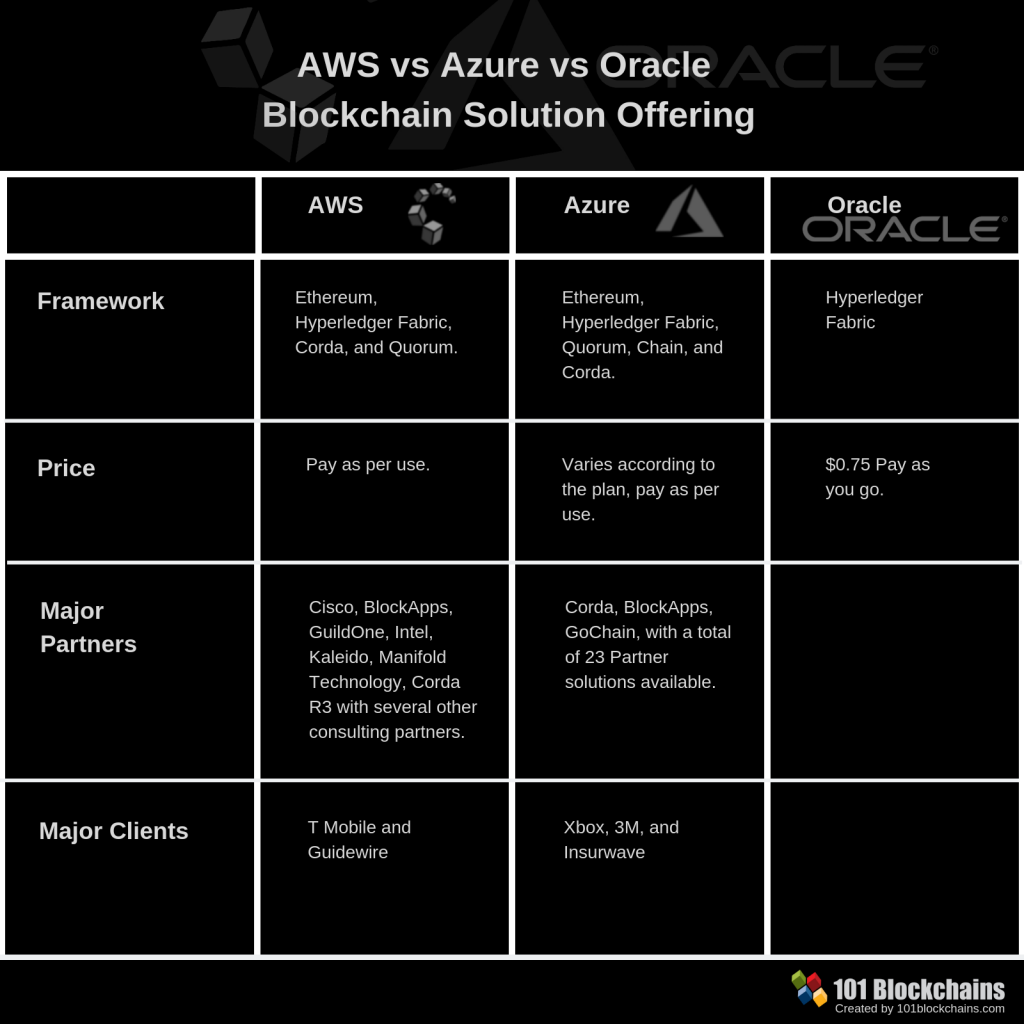
You need to decide whether to build the blockchain network from scratch, or use a third party blockchain solution like Azure blockchain, Oracle, or AWS blockchain. The former is time-consuming, whereas the latter could be up in as little as 30 minutes.

Each of the the aforementioned enterprise blockchains offer their own functionalities and features as well as cost advantages. Both AWS and Azure offers solutions for Ethereum, Hyperledger Fabric, Corda, and Quorum, while Oracle only caters for Hyperledger Fabric. We can compare their features in the following table:

Courtesy of 101 Blockchains


The cost of setting up Azure Blockchain Workbench is roughly $400-$500 depending on your region and usage. The main costs are three VMs and one app service. Two VMs are for the default blockchain network, and one VM is for the microservices on Workbench. For AWS Blockchain pricing, refer to: https://aws.amazon.com/managed-blockchain/pricing/

References

HR Blockchain Use Cases

Blockchain is not just about cryptocurrencies but it can be applied in businesses. In this article, we shall explore its application in human resource management. HR Blockchain use cases have started to emerge and have the potential to disrupt traditional HR systems. Among them are ChronoBank.io, PEACOUNTS,and bitWAGE 

Let’s examine each one of them.

ChronoBank.io

This is an HR blockchain platform designed to improve the recruitment process as well as payroll. It claimed that it will disrupt the HR industry similar to how Uber has disrupted the taxi industry.

ChronoBank ecosystem comprises a hiring platform(LaborX), a decentralized exchange(TimeX), a multi-signature wallet(Chronowallet) and a cryptocurrency that is pegged to labor hours(Labor Hour token).

LaborX is their flagship global hiring platform that connects candidates to the companies. It features an industry first immutable reputation system and a crypto payment system based on smart contract. The reputation system allows faster screening of candidates therefore save time and cost in hiring the right candidates. In addition, the crypto payment system enables candidates to get paid on time.

Furthermore, it plans to use a stable coin as the crypto payment to eliminate volatility common in most cryptocurrencies. This coin is known as Labour-Hour tokens. These tokens are linked to average hourly wages in the host country and are backed by a real labor force from big recruitment and labor-hire companies. Labor is considered a tradeable resource so ChronoBank will tokenise this resource into the LH-Tokens.

PeaCounts

PeaCounts is a blockchain-based payroll system. PeaCounts claimed that their payroll system will revolutionize the way employees are paid by using blockchain to remove the trust-based elements of the payroll process. It ensures the employees will get paid as soon as the work is completed. On the other hand, the employer will pay just for the work completed.

It features a smart contract that can track an employee location and time spent on certain tasks. It also holds the PEA Tokens and release them to the employee upon completion of the tasks. This system ensures that the employee gets paid efficiently and fairly.

The PeaCount payroll system is a private blockchain created as a fork off the Bitcoin. It also implements the zk-Snarks protocol and a multi-access wallet to ensure security in payroll transactions.

bitWage

bitWage is a payroll and HR services platform designed for the digital age. Basically it is a global outsourcing platform that serves the freelancers who wish to seek jobs worldwide and employers who wish to hire remote workers .

The bitWage payroll system allows employers to pay their remote employees rapidly with low transactions. The employees have the option to receive their wages and salaries in any of twenty four fiat currencies, four cryptocurrencies , and four precious metals.

References

HR Digital Transformation-powered by Blockchain

Human resource management has undergone tremendous changes in recent years particularly with regards to digitalization of human resource.  The emergence of blockchain technology could further transform the world of HR. 

According to Griffiths(cited in Gale, 2018), blockchain has the potential to streamline a lot of inefficient work related to employee data verification. Blockchain can store a candidate education, certifications and work history in a single ledger, therefore it would take just minutes rather than days to verify the data. Besides that,  the data cannot be modified or hacked once they are stored in the blockchain, thus guarantee data security and trustworthiness.

In addition, blockchain has the potential impact on HR by allowing personal data to be owned by the individual rather than the organization(Mike, cited in Gale 2018).  Consequently, every employee could maintain control over their entire employment data,  including educational background, training, and work history. It also means that an individual work identity is more portable, it moves with the individual rather than stuck inside the former organization when an employee changes job.  

Besides that, blockchain could disrupt conventional HR processes with respect to financial transactions.  Blockchain could streamline payroll function significantly by allowing automated and direct payment based on smart contarcts,  without the need of a  third party such as a bank or other intermediaries. 

Recently,  PWC (2018)has identified a few areas where we can apply the blockchain technology in HR. The areas include talent sourcing and management, targeting productivity gains, cross-border payment and mobility and Fraud prevention, and cybersecurity and data protection.

Talent sourcing and management

Blockchain could have a major impact on talent sourcing and management. It allows employees to maintain and control access to a comprehensive, trustworthy blockchain-based record of their education, skills, training and workplace performance. By providing potential employers with access to their blockchain-based employment data,  companies would be able to match individuals to roles much more accurately and effectively.

Targeting productivity gains

Blockchain has the ability to better match people’s skills and performance to jobs.  Finding and recruiting the right talent is always problematic for business organizations, therefore by helping them do this more effectively and efficiently will surely boost their productivity. Besides that, blockchain can help to reduce the burden of data-intensive processes like payroll and VAT ,  allowing companies to focus more on  their core businesses.

Cross-border payments and mobility

Multinational companies could create their own blockchain-based corporate cryptocurrencies that they can use for cross-border payment across their global supply chains, without the need of third-parties for settlement and reconciliation. In the future, central banks may legalize this type of cryptocurrency and support convertibility into fiat currencies. In addition, blockchain could facilitate employees mobility across the border with respect to payroll adjustment, international expenses, and taxes.

Fraud prevention, cybersecurity and data protection

HR department usually needs to handle high-volume financial transactions and sensitive personal data,  therefore it is utmost important to prevent frauds as well as to safeguard the data. This is the area where blockchain could be extremely useful. Blockchain’s use of consensus to authenticate data can help to eliminate frauds.

Another issue that blockchain can help to overcome is cyber threats. Many SMEs are ill-prepared for cyber attacks and the results could be detrimental to their businesses. Blockchain could help ensure cybersecurity as the data are immutable and tamper-proof because it uses SHA-256 hashing cryptography.  

References

A Wrap-up of Blockchain And Cryptocurrency Conference 2018

I am trying to summarize a bit of the Blockchain and Cryptocurrency conference 2018 (from 13th to 15th Nov 2018) but it is far from comprehensive as I missed out the first day programmes. Besides that, I  couldn’t capture all the mind-boggling stuff delivered by the elite speakers, all of them are crypto experts! I am sure all the participants benefited immensely in one way or another unless they slept   through the sessions.

The conference was co-organized by Twinintel, QF4 Tech Asia and Blueshare. The venue was at the impressive five-star Sheraton Imperial Hotel located at Jalan Sultan Ismail, Kuala Lumpur. The event was very well organized and the speakers’ line-up is simply overwhelming, kudos to the organizers!

The topics were very comprehensive and catered for everyone needs, be them crypto investors, tech-savvy nerds, govt officials, regulators(maybe hiding among us), academicians, and students etc.  I would say there were not much marketing hypes about ICO, mostly educational.  The topics covered ICO, ISTO, Crypto analytics, Blockchain training, Blockchain standards, Blockchain smart cities , fundamentals and more.

I was particularly impressed by the cool topic “Predicting Cryptocurrency Exchange Rate with AI and social media” delivered by Dr.Tim Frey.  I like forecasting the future as it is my personal interest , that was why I watched all the back to future and time machine movies. I learned how Dr.Tim used Twitter’ tweets (or rather gossips) as the data for his forecasting model, which gives an impressive level of 70%-90% accuracy. Maybe One day we can develop a forecasting model that can deliver 99% accuracy.  I believe by using AI machine learning we can achieve that goal. I managed to catch up with Dr.Tim at tea time to get more insights from him. According to him, it seemed 90% of the audience couldn’t grasp the concepts, I am not too sure. I myself don’t understand much too. For example,  I don’t know what the heck is Kappa Architecture, I am sure our computer science experts can understand better.

Dr.Sindhu illustration of Crypto banking was an eye-opener.  I like the diagram that showed clearly how various components from KYC, front-end app, ledger, and the blockchain’s bank wallet are connected to the bank’s backend. It showcases a banking model for the future crypto transaction. we also learned about the Microsoft, Ethereum and R3 11 banks experiment on simulation an exchange of value on the blockchain. The banks involved were HSBC, Credit Suisse, Barclays, Wells Fargo and more. Very useful for a case study. In addition, he also highlighted the advantages of using Blockchain in the banking industry:

  • Transparency
  • Less Labour intensive
  • Disintermediation
  • Tamper-proof
  • Nearly instantaneous

However, there are also some key challenges , as follows:

  • Privacy
  • Integration
  • Threat of Rivalry
  • Energy Consumption

I couldn’t remember who spoke on steps in launching an ICO but the points given were super good. According to him, the steps in doing an ICO are as follows:

  1. Decide if an ICO is suitable for your business
  2. Adviser reach out and on-boarding
  3. Get legal opinion
  4. Create a light paper/whitepaper/deck for your ICO
  5. Private sale or an angel investment to develop the MVP
  6. Create the product
  7. Create a token
  8. Create a community and buzz
  9. Getting your token out on an exchange

He further showed us the shocking statistics that 81% of the ICO projects were found to be a scam scheme. Out of the genuine ICO projects, 6% failed, another 5% gone dead and only a meagre 8% proceed to trade. Therefore the ICO projects are not as rosy as what people claim.

Another speaker spoke on potential blockchain applications. He subdivided the potential applications into four areas, smart contracts, digital currency, securities and record keeping.

The speaker from Cryptology gave advice for those who intend to start an ICO project. First of all, he reminded that blockchain is not a get rich quick scheme. It is about the distribution of trust. Secondly, do not just explore blockchain technology just because it is hot or trendy. Think in terms of how the product or services can benefit from it. Finally, bear in mind that the most successful companies are those who can accept and adapt to constant changes.

Miss Daphne Chong, the CTO from Logistics Worldwide Express and a director of Woman Who Code KL explained how blockchain could disrupts the supply chain and logistics industry. She emphasized on the advantages of implementing blockchain  in supply chain and logistics in terms of

  • Efficiency-less paperwork, elimination of the intermediaries
  • Transparency-price, ownership, location
  • Inventory tracking, quality control
  • Disputes settlement, reduction in cost of regulations and compliance

Last but not least, Mr. Fattah, the chairman of Malaysia’s National Standards Committee on Blockchain and Distributed Ledger Technologies told the audience about the development of Blockchain and DLT standards in Malaysia. He spearheaded the formation of the national committee and played a key role in putting Malaysia on the international scene. You can follow his blog https://fattahyatim.wordpress.com/ to learn more about the subject.

This is all about the conference that I can recollect, I welcome your valuable inputs if I have missed out anything important.