Build a Sample Coin with Truffle

🚀 New Tutorial: Create a Cryptocurrency Using Solidity and Truffle

I have just published a new hands-on tutorial that shows how to build a sample cryptocurrency using the Truffle Framework and Solidity on Ethereum.

In this tutorial, you will learn how to:
✔ Set up a blockchain development environment
✔ Create a smart contract using Solidity
✔ Compile and test contracts with Truffle
✔ Interact with the contract using Web3
✔ Deploy the contract to a local blockchain using Ganache

This practical example uses the MetaCoin project, which is a great starting point for developers who want to understand how cryptocurrencies and smart contracts work on Ethereum.

Check out the tutorial here:

https://www.blockchainguide.biz/crypto-tutorial/index.html

Solidity Tutorial – Learn Ethereum Smart Contract Programming

Blockchain technology is revolutionizing the digital world, and Solidity has become one of the most important programming languages in Web3 development. If you want to build decentralized applications (dApps), create tokens, or develop smart contracts on Ethereum, learning Solidity is an essential skill.

To help beginners get started, I have created a comprehensive free Solidity tutorial that explains blockchain programming step by step.

👉 Start learning Solidity here:
https://www.blockchainguide.biz/solidity-tutor/index.html


What is Solidity?

Solidity is a high-level programming language used to write smart contracts that run on the Ethereum Virtual Machine (EVM). Smart contracts are self-executing programs stored on the blockchain that automatically enforce agreements between parties without intermediaries.

Solidity is widely used to develop:

  • Decentralized applications (dApps)
  • DeFi protocols
  • NFT smart contracts
  • Cryptocurrency tokens (ERC-20, ERC-721, etc.)
  • Blockchain governance systems

The syntax of Solidity is influenced by languages such as JavaScript, Python, and C++, making it easier for programmers to transition into blockchain development.


Why Learn Solidity?

The demand for blockchain developers is growing rapidly as companies explore decentralized technologies. By learning Solidity, you can:

  • Build Ethereum smart contracts
  • Develop Web3 applications
  • Create your own cryptocurrency tokens
  • Work on NFT and DeFi projects
  • Participate in the rapidly expanding blockchain ecosystem

For developers interested in Web3 careers, Solidity remains one of the most valuable programming skills today.


Free Solidity Tutorial for Beginners

The Solidity tutorial on BlockchainGuide.biz provides a beginner-friendly introduction to smart contract programming.

In this tutorial, you will learn:

  • Introduction to Ethereum and smart contracts
  • Basic Solidity syntax
  • Variables, functions, and data types
  • Writing and compiling your first smart contract
  • Deploying contracts to the blockchain
  • Practical programming examples

The lessons are designed to help students, programmers, and blockchain enthusiasts learn Solidity in a structured and easy-to-understand way.

👉 Access the tutorial here:
https://www.blockchainguide.biz/solidity-tutor/index.html


Who Should Learn Solidity?

This tutorial is ideal for:

  • Beginner programmers interested in blockchain
  • Web developers moving into Web3 development
  • Students learning decentralized technologies
  • Entrepreneurs building blockchain applications

No prior blockchain experience is required, although basic programming knowledge will be helpful.


Start Your Blockchain Development Journey

Solidity programming is the foundation of many decentralized systems running on Ethereum and other EVM-compatible blockchains. Learning how to write smart contracts gives you the ability to build secure, transparent, and trustless applications.

If you want to explore the exciting world of Web3 development, start learning Solidity today.

🚀 Begin your Solidity journey now:
https://www.blockchainguide.biz/solidity-tutor/index.html

Beyond Bitcoin: Understanding the Difference Between Blockchain and Crypto


Introduction

When people hear the word blockchain, the first thing that often comes to mind is Bitcoin or cryptocurrency. While it’s true that blockchain technology powers cryptocurrencies, the two terms are not interchangeable. In fact, the widespread association of blockchain with crypto has caused significant confusion and even skepticism in the general public.

This blog post aims to clear up that confusion. We’ll explain the fundamental difference between blockchain and cryptocurrency, and explore the wide array of real-world applications of blockchain technology — far beyond digital currencies.


What Is Blockchain?

At its core, blockchain is a type of distributed ledger technology (DLT). Think of it as a secure, digital record-keeping system that is shared across a network of computers. Each record (or “block”) is linked to the previous one, forming a “chain” that is immutable — meaning it cannot be altered once added.

The key features of blockchain include:

  • Transparency: Everyone in the network can view the same data.
  • Security: Data is encrypted and validated through consensus mechanisms.
  • Decentralization: No single authority controls the network.
  • Immutability: Records are permanent and tamper-proof.

What Is Cryptocurrency?

Cryptocurrency is a digital or virtual currency that uses cryptography for security. Cryptocurrencies like Bitcoin, Ethereum, and many others use blockchain to record transactions securely and transparently.

In simple terms:

Cryptocurrency is just one application of blockchain technology — not the technology itself.


Why the Confusion?

The confusion arises because Bitcoin was the first popular application of blockchain technology. For many people, their first and only exposure to blockchain has been through crypto trading, investing, or news coverage related to scams, price swings, or regulatory crackdowns.

This limited exposure creates the false impression that blockchain equals cryptocurrency, which is far from the truth.


Blockchain Applications Beyond Cryptocurrency

Here are several industries where blockchain is being used today — without involving cryptocurrencies:


1. Supply Chain Management

Blockchain allows companies to track goods from their origin to the end consumer. This improves transparency, prevents fraud, and ensures ethical sourcing (e.g., tracing whether diamonds or cocoa are conflict-free).

Example: IBM’s Food Trust platform helps companies trace the journey of food items, improving safety and reducing waste.


2. Healthcare

Blockchain can be used to secure patient records, ensuring that data is accessible only to authorized parties and protected from tampering or hacking.

Example: MedicalChain and other projects use blockchain to allow patients to control access to their own health data.


3. Voting Systems

Blockchain can power secure, transparent, and tamper-proof digital voting, potentially solving problems of election fraud and increasing voter trust.

Example: Estonia and some U.S. states have piloted blockchain voting systems.


4. Digital Identity

Blockchain can be used to create self-sovereign digital identities that are secure and verifiable — reducing identity theft and simplifying access to services.

Example: Projects like ID2020 and Sovrin aim to provide blockchain-based digital identity systems for refugees and underserved populations.


5. Finance and Banking (Beyond Crypto)

Banks are using blockchain for cross-border payments, smart contracts, and real-time settlement — increasing speed, reducing fees, and improving security.

Example: JP Morgan’s Onyx platform and RippleNet use blockchain for fast, international transactions without relying on cryptocurrencies directly.


6. Real Estate and Land Registry

Blockchain can simplify the process of buying and selling property by recording ownership, preventing fraud, and reducing paperwork.

Example: Countries like Sweden and Georgia have adopted blockchain to record land titles.


7. Education and Credentials

Universities and institutions are issuing tamper-proof academic certificates on the blockchain that are instantly verifiable by employers.

Example: MIT issues blockchain-based diplomas that graduates can share with employers or institutions globally.


Final Thoughts

It’s time to separate the technology (blockchain) from just one of its use cases (cryptocurrency). While cryptocurrencies have their place, the potential of blockchain stretches far beyond digital coins.

From revolutionizing healthcare and education to transforming government and finance, blockchain is poised to be one of the most impactful technologies of our time.

Understanding this distinction helps us better embrace innovation — and move past the hype or fear often associated with crypto headlines.


Call to Action
If you’ve only associated blockchain with Bitcoin, now is the time to dig deeper. Explore how this powerful technology can transform industries and improve trust, transparency, and efficiency in everyday life.

Stay informed. Stay curious. The future is blockchained — with or without the coins.
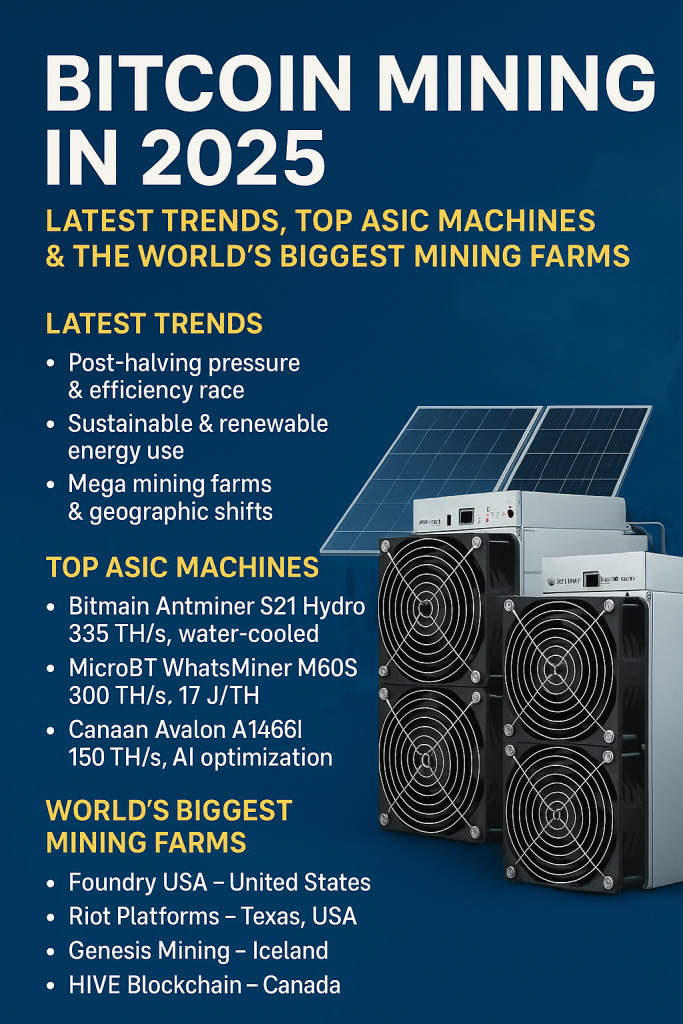

Bitcoin Mining : Latest Trends, Top ASIC Machines & the World’s Biggest Mining Farms


Bitcoin mining remains one of the most critical components of the cryptocurrency ecosystem. As we move deeper into 2025, mining continues to evolve rapidly with powerful new ASIC machines, an increased focus on sustainability, and the expansion of mega-sized mining farms across the globe.

This guide will walk you through what Bitcoin mining is, the latest trends shaping the industry, the best mining hardware available today, and a look inside some of the world’s largest mining operations. We’ll also briefly explore other cryptocurrencies still using Proof-of-Work (PoW).


🔹 What Is Bitcoin Mining?

Bitcoin mining is the process of validating transactions and securing the Bitcoin network by solving complex cryptographic puzzles. Miners compete to be the first to solve each puzzle, and the winner gets to add a new block to the blockchain, receiving a reward in newly minted bitcoins and transaction fees.

This process relies on the Proof-of-Work (PoW) consensus mechanism and requires significant computing power and energy. With each Bitcoin halving (the most recent occurred in April 2024), block rewards are reduced—making efficiency more crucial than ever.


🔹 Latest Bitcoin Mining Trends in 2025

1. Post-Halving Pressure & Efficiency Race

After the 2024 halving reduced block rewards from 6.25 BTC to 3.125 BTC, miners are under pressure to reduce operating costs and maximize performance. Only the most energy-efficient and high-hashrate setups remain profitable.

2. Sustainable & Renewable Energy Use

The environmental impact of mining has drawn global attention. In response, many miners now operate in regions with cheap, clean energy:

  • Iceland & Norway – Geothermal and hydro power
  • Texas, USA – Wind and solar integration with grid balancing
  • Canada – Abundant hydroelectric energy

This shift is not just environmental—it’s also economical, as electricity is the biggest cost factor in mining.

3. Mega Mining Farms & Geographic Shifts

Regulations have pushed mining out of countries like China, redirecting investment to North America, Central Asia, and parts of South America. Massive, industrial-scale mining farms now dominate Bitcoin’s hash power.

4. Mining-as-a-Service (MaaS) & Cloud Solutions

Companies offer hosted mining services, allowing individuals and investors to mine without setting up hardware. This trend makes mining more accessible but also comes with trust and ROI concerns.

5. Decentralized Mining Pools

To reduce centralization risks, miners are joining non-custodial, transparent pools like Ocean or ViaBTC, where they retain control of their mining rewards and payout transparency is emphasized.


🔹 Top ASIC Mining Machines of 2025

Mining hardware is the foundation of any operation. The newest generation of ASIC (Application-Specific Integrated Circuit) miners is optimized for performance and energy savings.

🔸 1. Bitmain Antminer S21 Hydro

  • Hashrate: 335 TH/s
  • Efficiency: ~16 J/TH
  • Cooling: Advanced water-cooled system
  • Highlights: Ideal for large-scale, high-density mining farms.

🔸 2. MicroBT WhatsMiner M60S

  • Hashrate: 300 TH/s
  • Efficiency: ~17 J/TH
  • Known for: Reliability, simple firmware, and lower failure rate.

🔸 3. Canaan Avalon A1466I

  • Hashrate: 150 TH/s
  • Features: Built-in AI optimization, better thermal controls.
  • Use case: Mid-sized farms and power-sensitive operations.

These machines are in high demand and form the backbone of 2025’s top mining farms.


🔹 Leading Bitcoin Mining Farms in the World

Bitcoin mining is no longer a garage operation. Massive farms—some the size of data centers—are now driving most of the network’s hash power.

🔸 1. Foundry USA – United States

  • The largest mining pool in North America.
  • Backed by Digital Currency Group.
  • Operates large-scale mining with sustainable energy integration.

🔸 2. Riot Platforms – Texas, USA

  • One of the biggest Bitcoin miners globally.
  • Strategically located to access Texas’ renewable energy grid.
  • Focuses on eco-friendly, large-scale operations.

🔸 3. Genesis Mining – Iceland

  • Early adopter of green energy for mining.
  • Operates in Iceland using geothermal power.
  • Also offers cloud mining services.

🔸 4. HIVE Blockchain – Canada & Europe

  • Publicly traded and ESG-focused.
  • Leverages hydropower in Canada and Sweden.
  • Diversifies with mining of other PoW coins.

🔸 5. Bitmain Farms – Kazakhstan, USA

  • Despite China’s crackdown, Bitmain continues offshore mining.
  • Runs some of the most efficient, high-density farms.

These entities control significant portions of the global hash rate, influencing block generation and mining profitability.


🔹 Other Mineable Cryptocurrencies (2025)

While Bitcoin dominates mining, several altcoins still use PoW and can be mined with GPUs or CPUs:

  • Litecoin (LTC): Uses Scrypt; often mined alongside Dogecoin.
  • Monero (XMR): Uses RandomX; privacy coin that supports CPU mining.
  • Ethereum Classic (ETC): Continues to use Etchash after Ethereum’s PoS shift.
  • Kaspa (KAS): A fast-emerging PoW project using DAG and kHeavyHash.

These coins are especially attractive for hobbyists or miners priced out of Bitcoin mining.


🔹 Final Thoughts

In 2025, Bitcoin mining is more competitive and industrialized than ever. The combination of cutting-edge ASIC hardware, geographic migration, and a global push for green energy is reshaping the entire landscape.

Whether you’re an investor, miner, or enthusiast, understanding these trends—and staying updated on the latest machines and farms—is essential. Bitcoin’s next halving cycle is already in sight, and the mining race is only getting hotter.


AI and Blockchain: The Perfect Combination for a Secure and Intelligent Digital Future


Introduction

Artificial Intelligence (AI) and blockchain are two of the most transformative technologies of our time. AI brings intelligence, automation, and creativity, while blockchain ensures transparency, data integrity, and security. When combined, these two powerful forces complement each other to create robust, privacy-respecting, and highly efficient digital systems. The convergence of AI’s generative capabilities with blockchain’s secure and decentralized infrastructure is not just a trend—it’s a revolution in the making.


1. The Rise of Generative AI

Generative AI, especially large language models (LLMs) and image synthesis models, has demonstrated tremendous power in creating content, writing code, generating art, composing music, and even designing complex systems. From ChatGPT to DALL·E, these models are transforming industries by automating creative and cognitive tasks.

However, this explosion of AI-generated content also raises critical concerns:

  • Data authenticity: Who created the content? Can we trust it?
  • Ownership rights: Who owns the data generated by AI?
  • Privacy: Is the training data ethically sourced and protected?

These are questions that blockchain is uniquely positioned to answer.


2. Blockchain: Trust, Transparency, and Data Sovereignty

Blockchain technology is fundamentally a decentralized, tamper-resistant ledger. It excels in ensuring:

  • Data integrity: Once data is recorded, it cannot be altered without consensus.
  • Decentralization: No single point of failure or control.
  • User privacy and sovereignty: Through self-sovereign identity (SSI) and cryptographic tools like zero-knowledge proofs.

In AI, where data is both the input and the output, blockchain ensures that this data is secure, traceable, and ethically managed.


3. The Symbiotic Relationship: AI + Blockchain

a. Provenance and Trust in AI-Generated Content

Blockchain can store metadata about AI-generated content—such as when it was created, by whom, using which model—ensuring provenance. This makes it possible to verify the authenticity of content in a world plagued by deepfakes, misinformation, and AI-generated media.

b. Training Data Transparency

AI models often require massive datasets to train. Blockchain can record where training data comes from, how it was obtained, and under what licensing terms—ensuring ethical AI and helping mitigate bias or misuse.

c. Incentivized Data Sharing

Through tokenization and smart contracts, blockchain can create marketplaces where users are rewarded for sharing data securely with AI developers. This opens up privacy-preserving, decentralized AI training systems that don’t rely on big tech monopolies.

d. Decentralized AI Models

By integrating blockchain, AI models can be deployed on decentralized networks (e.g., the Internet Computer, Ocean Protocol, or Fetch.ai), allowing models to run without centralized servers, reducing censorship, and increasing resilience.


4. Real-World Use Cases

  • Healthcare: AI analyzes patient data for diagnosis, while blockchain ensures the data remains private, auditable, and owned by the patient.
  • Finance: AI detects fraud in real time, while blockchain provides transparent transaction logs that cannot be altered.
  • Supply Chain: AI predicts delays or optimizes routes, while blockchain ensures the traceability of goods from source to shelf.
  • Digital Identity: AI verifies identity biometrics, while blockchain anchors that identity in a tamper-proof, self-sovereign framework.

5. Challenges and the Road Ahead

While the combination is promising, integration comes with challenges:

  • Scalability: Blockchain networks must handle AI’s data throughput demands.
  • Interoperability: Connecting different blockchains and AI systems seamlessly.
  • Regulation: Both fields face evolving regulatory scrutiny, especially around data protection and accountability.

Nevertheless, as Web3 infrastructure matures and AI governance frameworks evolve, this fusion will become more seamless and powerful.


Conclusion

The marriage of AI and blockchain is more than a technological convergence—it’s the foundation of a new digital paradigm. AI gives systems the ability to learn, create, and make decisions. Blockchain ensures those systems remain secure, transparent, and accountable. Together, they empower a future where innovation doesn’t come at the cost of trust, privacy, or ethical responsibility.

As we stand at the intersection of intelligence and integrity, AI and blockchain are not just complementary—they are indispensable allies shaping the next generation of the internet.